Back
Beestige tijdreizigers
Discover and learn about animal speed through playful interactive races in a tangible museum installation using RFID and motion.
Period
Sep 2025 - Jan 2026
Technologies
C++ (Arduino)
Python (Raspberry Pi)
RFID
FastLED
AccelStepper
Overview
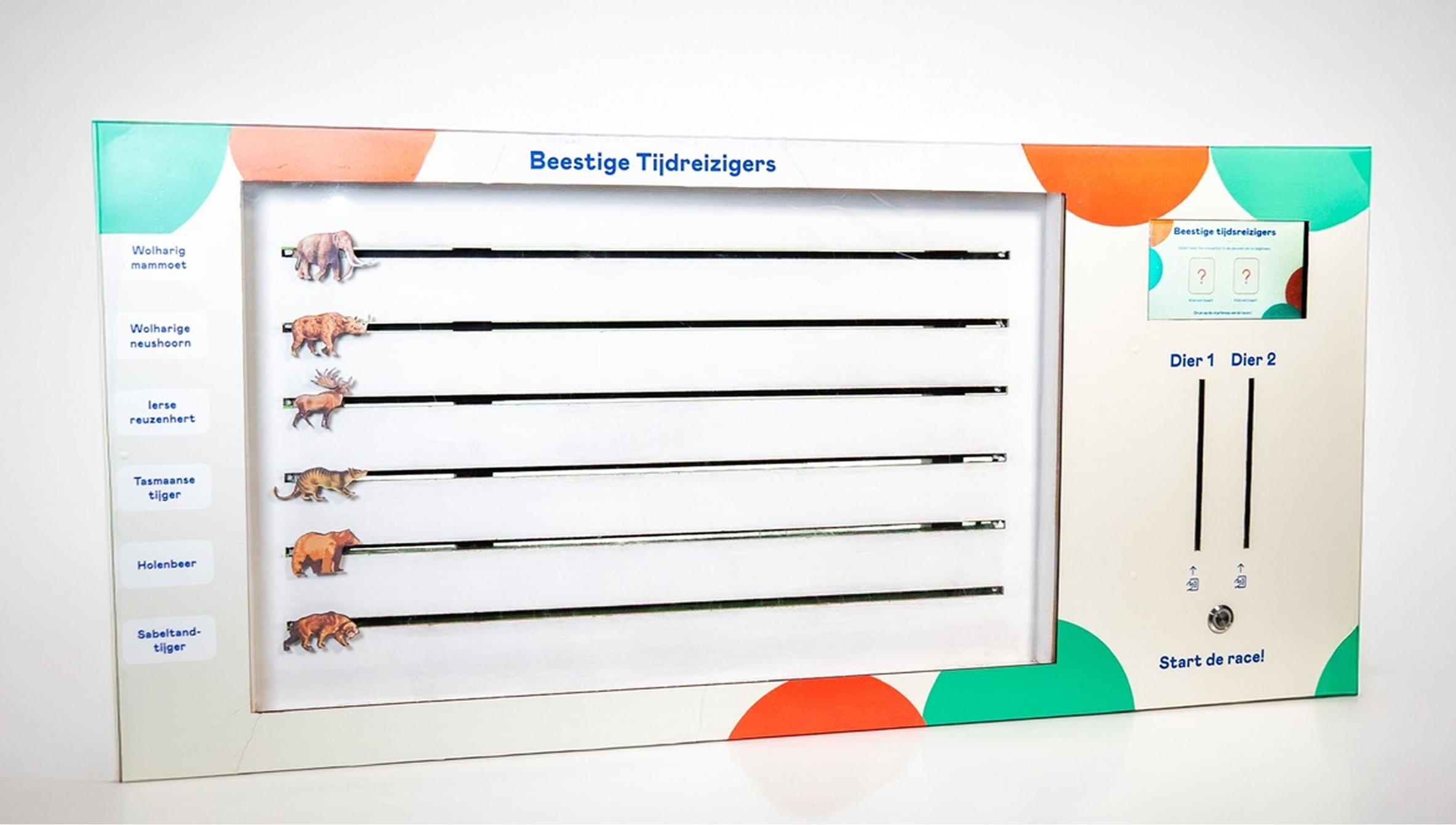
Beestige tijdreizigers is an interactive educational installation developed for the Huis van Kina, a natural history museum in Ghent. The installation was designed to help children discover and learn about the speed of prehistoric animals through a playful and tangible experience.
Instead of presenting information passively, the installation invites visitors to actively participate. Children select two animals using physical RFID cards and let them compete in a race inside a custom-built racebox. Each animal moves across its own rail at a speed that reflects its real-world movement speed, allowing visitors to visually compare differences between species.
During and after the race, additional information is shown on a screen, including speed in kilometers per hour and contextual details about the animals. The installation combines motion, light, sound and physical interaction to create an engaging learning experience that connects digital technology with physical objects.
The racebox itself is constructed from durable multiplex wood and designed specifically for museum use. Laser-cut wooden animals move behind a transparent protective layer, ensuring both safety and long-term reliability in a public environment.
This project was developed in team together with Joran Vreye, Emie Van de Veire and Simon Van Tomme.
Challenge
The primary challenge was to design an installation that is both educational and highly engaging for children between six and twelve years old. The experience needed to be intuitive without requiring instructions, allowing visitors to immediately understand how to interact with the system.
At the same time, the installation had to meet the technical and physical requirements of a museum environment. This included ensuring durability, reliability and safe operation during continuous public use.
Several technical challenges had to be addressed:
- Ensuring reliable RFID detection without duplicate or missed readings
- Controlling multiple stepper motors with different speeds smoothly and accurately
- Automatically resetting animals to their starting positions after each race
- Providing clear visual and audio feedback to guide the user experience
- Creating a system that starts safely and predictably after power interruptions
The installation also needed to integrate physical mechanics, electronics and software into one cohesive and maintainable system.
Solution
The final solution is a fully integrated interactive racebox combining embedded electronics, mechanical motion and a digital interface. Visitors select animals using RFID cards, which are detected by RFID readers connected to an Arduino Uno. The Arduino processes input and controls stepper motors that move the animals along rails at predefined speeds.
Each animal is mounted on a timing belt mechanism driven by a NEMA 17 stepper motor. Endstop switches ensure precise positioning and allow the system to automatically reset after each race. LED strips provide dynamic visual feedback throughout the experience, including countdown, race progress and winner indication.
A Raspberry Pi controls the visual interface displayed on an external screen. It provides contextual information about the selected animals and reinforces the educational aspect of the installation.
The entire system is housed in a custom-designed wooden enclosure, built for durability, safety and easy maintenance. The use of modular components ensures the installation can be serviced and updated when needed.
Results
The result is a fully functional interactive museum installation deployed for the Huis van Kina in Ghent. The installation successfully transforms abstract information about animal speed into a tangible and memorable experience.
Children actively engage with the installation by selecting animals, observing the race and comparing outcomes. The combination of physical interaction, movement and real-time feedback increases curiosity and supports learning through play.
The project demonstrates the integration of embedded systems, IoT principles and physical computing in a real-world public environment. It also highlights the importance of designing technology that is not only functional, but intuitive, durable and meaningful within its context.
Beestige tijdreizigers shows how interactive technology can enhance museum experiences by making educational content more accessible, engaging and interactive for younger audiences.